Introduction
Education is a crucial building block of society, shaping how we think, learn, and interact. Understanding cognitive development theories is vital for educators, parents, and learners alike. The theories of Jean Piaget and Lev Vygotsky have profoundly influenced our educational systems and our perception of how children learn. This article explores these influential theories, illuminating their implications for modern classroom practices and providing actionable insights to enrich the learning experience.
Prepare to embark on a comprehensive exploration of cognitive development, from Piaget’s stages of cognition to Vygotsky’s social constructivism. Together, we’ll uncover how these theories can be effectively applied in the classroom for optimal learning outcomes.
Table of Contents
- Understanding Cognitive Development
- Jean Piaget’s Theory of Cognitive Development
- Stages of Cognitive Development
- Practical Application in the Classroom
- Lev Vygotsky’s Sociocultural Theory
- Key Concepts
- Practical Application in the Classroom
- Comparative Analysis of Piaget and Vygotsky
- Integrating Both Theories for Classroom Success
- Conclusion
- FAQs
Understanding Cognitive Development
Cognitive development refers to the progression of thinking, problem-solving, and decision-making abilities that occur as a person matures. This process is particularly significant in childhood, as it lays the foundations for future learning. The theories of Piaget and Vygotsky provide a framework for understanding how children acquire knowledge and the best practices for facilitating their learning.
Why These Theories Matter
- Educator Insight: Helps teachers tailor their methods according to developmental stages.
- Enhanced Learning: Guides the creation of engaging and effective classroom environments.
- Child-Centric Approach: Focuses on children’s needs and learning styles, making education more relevant.
Jean Piaget’s Theory of Cognitive Development
Stages of Cognitive Development
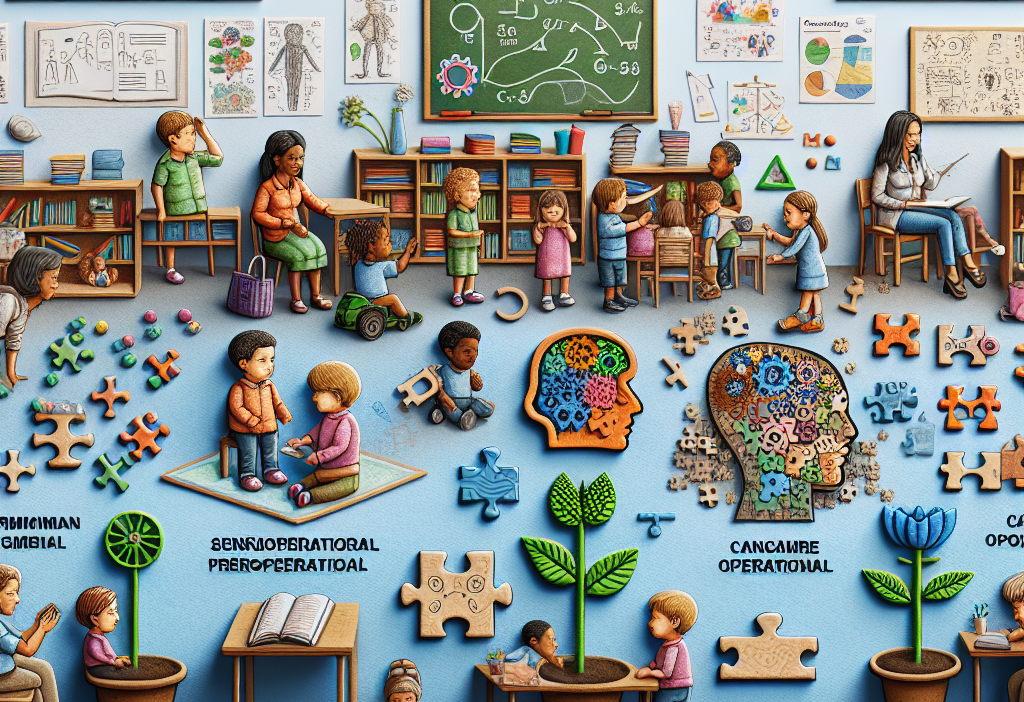
Jean Piaget proposed that children’s cognitive development occurs in four distinct stages:
Sensorimotor Stage (0-2 years):
- Infants learn through sensory experiences and manipulating objects.
- Example: A child learns that shaking a rattle produces sound through experimentation.
Preoperational Stage (2-7 years):
- Characterized by symbolic thinking, language development, and egocentrism.
- Example: A preschooler may engage in imaginative play and struggle to see things from another person’s perspective.
Concrete Operational Stage (7-11 years):
- Children begin to think logically about concrete events.
- Example: A child can perform basic mathematical operations or understand the concept of conservation (the idea that quantity does not change despite shape alterations).
- Formal Operational Stage (11 years and up):
- Development of abstract reasoning and hypothetical thinking.
- Example: Teenagers can strategize and plan for future events or consider various possibilities in solving complex problems.
Practical Application in the Classroom
To effectively employ Piaget’s theory in teaching, follow these steps:
- Assess Developmental Stages: Create lesson plans that align with the cognitive stages of your students.
Hands-On Learning: Engage students through concrete experiences. For instance:
- Use manipulatives in math to enhance understanding of abstract concepts.
- Encourage Exploration: Create an environment where curiosity is nurtured. For example:
- Allow students to conduct scientific experiments to derive their own conclusions.
Lev Vygotsky’s Sociocultural Theory
Key Concepts
Lev Vygotsky emphasized the role of social interaction and culture in cognitive development. Key concepts include:
- Zone of Proximal Development (ZPD): The difference between what a learner can do independently and what they can achieve with guidance.
- Scaffolding: Providing support to learners within their ZPD, gradually reducing this support as they become more proficient.
Practical Application in the Classroom
Implementing Vygotsky’s theories can be transformative. Here’s how you can do it:
Group Work: Foster collaborative learning by grouping students. Encourage peer tutoring, where more knowledgeable peers assist those who are struggling.
Discussion-Based Learning: Incorporate discussions and debates in the classroom, allowing students to articulate their thoughts and challenge one another in a supportive environment.
- Guided Discovery: Use guided discovery methods where teachers provide prompts or questions rather than direct instructions. This encourages deeper learning through exploration.
Comparative Analysis of Piaget and Vygotsky
| Feature | Piaget | Vygotsky |
|---|---|---|
| Focus | Individual cognitive development | Social and cultural factors impacting development |
| Key Concept | Stages of development | Zone of Proximal Development (ZPD) |
| Role of Teacher | Facilitator in exploration | Guide and mentor |
| View on Learning | Individual discovery | Collaborative and social |
Key Differences to Note
- Individual vs. Social: Piaget emphasized the individual journey of learning, while Vygotsky highlighted the importance of social context.
- Static vs. Dynamic: Piaget’s stages are seen as fixed, whereas Vygotsky’s approach allows for a more fluid understanding of cognitive growth.
Integrating Both Theories for Classroom Success
Bridging the insights from both Piaget and Vygotsky provides a comprehensive framework for enhancing educational practices. Here’s how to integrate their theories effectively:
Balanced Approach: Combine hands-on learning and social interaction. For example, during a science experiment, allow students to work together while also providing individual tasks.
Tailored Instruction: Use assessments to identify each student’s cognitive stage (Piaget) and tailor interactions to promote collaborative learning (Vygotsky).
- Promote Inquiry-Based Learning: Encourage students to form hypotheses and explore questions collaboratively, enhancing their cognitive abilities while benefiting from peer support.
Action Steps for Educators:
- Assess and document developmental stages of your students.
- Design lessons that incorporate both individual work and group collaboration.
- Reflect on your teaching practice and adjust strategies based on students’ needs.
Conclusion
Understanding the theories of cognitive development from Piaget to Vygotsky enriches the teaching and learning experience. By blending Piaget’s focus on individual cognitive stages with Vygotsky’s sociocultural approaches, educators can create dynamic and effective classroom environments.
Empower your students by fostering both independent and collaborative learning, thus preparing them for a future of lifelong learning. As you embrace these theories, remember: the ultimate aim is to cultivate a generation that not only knows how to learn but also thrives in social and collaborative settings.
FAQs
1. What are the main differences between Piaget and Vygotsky?
Answer: Piaget focused on individual cognitive development with structured stages, while Vygotsky emphasized the role of social interaction and culture in learning.
2. How can I apply Piaget’s theory in my lessons?
Answer: Align your lessons with the developmental stages of your students, providing appropriate hands-on experiences that correspond to their cognitive capabilities.
3. What is the Zone of Proximal Development (ZPD)?
Answer: ZPD is the gap between what a learner can do independently and what they can achieve with guidance or collaboration. It’s a crucial concept in Vygotsky’s theory.
4. How do I encourage group work in my classroom?
Answer: Promote collaborative projects, peer tutoring, and discussion forums to enhance social learning based on Vygotsky’s principles.
5. Can I use both theories together in my teaching?
Answer: Absolutely! Integrating both theories allows for a more holistic approach to education that accommodates individual learning while promoting collaboration.
By understanding and applying the profound insights from both Piaget and Vygotsky, educators can significantly enhance cognitive development in their classrooms. Embrace these theories, continue learning, and inspire your students to explore the world of knowledge! 😊