Faith and Foundations: The Ultimate Impact of Religion on India’s Historical Landscape
Introduction
India, often described as a mosaic of cultures, religions, and traditions, has a rich historical landscape that has been profoundly shaped by faith. From ancient times through the many dynasties to the modern nation-state, religion has served as both a glue binding communities and a catalyst for change. Faith and Foundations: The Impact of Religion on India’s Historical Landscape is not just an exploration of religious practices; it’s an examination of how belief systems have influenced social structure, politics, art, and everyday life in this diverse country.
In this comprehensive article, we’ll delve into the significant roles that major religions have played in shaping India’s past and present. We’ll explore historical moments, movements, and how faith has impacted everything from governance to social justice. By the end of our deep dive, readers will understand the multifaceted ways religion continues to influence contemporary India and possess insights into how faith and historical foundations interplay in the construction of identity.
The Major Religions of India: A Brief Overview
Before we delve deeper into the individual influences of religions, it’s essential to understand the prevalent faith systems in India.
Hinduism
- Overview: With over 1 billion adherents, Hinduism is often considered India’s primary religion. It’s characterized by a multitude of deities, rituals, and philosophical schools of thought.
- Historical Impact: Ancient texts like the Vedas and Upanishads have not only shaped spiritual beliefs but also laid the foundations for various social and cultural practices.
Buddhism
- Overview: Founded in the 6th century BCE, Buddhism arose in India with the teachings of Siddhartha Gautama (Buddha).
- Historical Impact: Buddhism promoted values of non-violence and compassion, influencing governance, especially during the Mauryan Empire.
Jainism
- Overview: Around the same time as Buddhism, Jainism emphasized non-violence (ahimsa) and truth.
- Historical Impact: Jain merchants played a pivotal role in trade, significantly impacting the economy during the medieval period.
Sikhism
- Overview: Founded in the 15th century, Sikhism advocates for equality, community service, and devotion to one God.
- Historical Impact: The Sikh Gurus challenged religious orthodoxy and served as symbols of resistance against oppression.
Islam
- Overview: Introduced to India by traders and conquerors, Islam has become the second-largest religion in the country.
- Historical Impact: The Mughal Empire exemplified how Islamic rule influenced art, culture, and architecture, melding elements with local traditions.
Christianity
- Overview: With roots tracing back to apostolic times, Christianity expanded in India mainly through colonial influence.
- Historical Impact: Christian missionaries significantly contributed to education and social reform movements in modern India.
Faith and Foundations: Ancient Influences
Early Civilizations and Their Beliefs
India’s early civilizations, such as the Indus Valley Civilization, exhibited signs of worship through their intricate rituals and cultural practices. The development of religious structures during this period laid the groundwork for later philosophical thought.
The Evolution of Dharma
A pivotal concept within Hinduism, Dharma, pertains to duty, law, and righteousness. It informs not only individual behavior but also societal norms. This principle has profoundly influenced kingship in ancient India, leading to just governance and social responsibility.
Religious Syncretism
- Cultural Integration: During various periods, such as the Gupta Era, diverse religious practices intertwined. This syncretism led to a rich cultural tapestry, with festivals, languages, and norms merging beautifully.
Table 1: Major Religions Influencing India’s Historical Landscape
| Religion | Founded | Major Beliefs | Key Historical Influence |
|---|---|---|---|
| Hinduism | Ancient | Karma, Dharma, Reincarnation | Social structure and ritual practices |
| Buddhism | 6th century BCE | Four Noble Truths, Eightfold Path | Promoted non-violence and moral governance |
| Jainism | 6th century BCE | Ahimsa, non-possessiveness | Trade and economic development |
| Sikhism | 15th century | Equality, community service | Resistance against oppression |
| Islam | 7th century | Monotheism, Five Pillars of Islam | Influence on art and governance during Mughals |
| Christianity | 1st century | Love, forgiveness, community | Education and social reform |
Faith and Governance: Political Implications of Religion
The Mauryan Empire: Ashoka’s Edicts
Ashoka the Great, a pivotal figure in Buddhism’s spread, implemented his teachings into statecraft. His edicts conveyed principles of tolerance, peace, and social welfare, influencing governance in subsequent Indian kingdoms.
Mughal Empire: A Blend of Cultures
The Mughals were known for their secular policies amidst a predominantly Hindu populace. Akbar the Great famously engaged in dialogue among religions and established a syncretic faith, Din-i Ilahi, aimed at fostering unity.
Colonial Interactions and Reformation
British colonial rule introduced a new paradigm, leading to a complex interaction between faith and politics:
- Reform Movements: Influential reformers like Raja Ram Mohan Roy sought to modernize society while staying true to their faiths, thus impacting social norms and laws in India.
- Nationalist Movements: Religion often intertwined with the struggle for independence, as leaders like Mahatma Gandhi emphasized common spiritual ground among various faiths.
Chart 1: Key Political Figures Influenced by Religion in India
| Name | Religion | Impact |
|---|---|---|
| Ashoka | Buddhism | Policies of peace and welfare |
| Akbar the Great | Islam | Secular governance and religious dialogues |
| Mahatma Gandhi | Hinduism | Non-violent resistance influenced by faith |
Societal Transformations: The Role of Religion in Social Change
Caste System and Religion
The Hindu caste system, a complex social hierarchy, has its roots in ancient texts. While controversial, it shaped social interactions, occupations, and even politics. Reformers like Dr. B.R. Ambedkar sought to dismantle these barriers, paving the way for a more equitable society.
Women’s Rights and Religious Reforms
Religious texts and practices have often dictated women’s roles in society. However, many reform movements, including those led by figures like Sarojini Naidu and Kamaladevi Chattopadhyay, sought to uplift women’s status by addressing issues like education and property rights.
Contemporary Challenges
As India grapples with rapid modernization, religious identities often collide with progressive movements. Issues like interfaith marriages, caste discrimination, and religious conversions continue to spark debates, influencing social norms and policies.
Table 2: Influence of Religion on Social Reform Movements
| Movement | Key Figures | Main Goals |
|---|---|---|
| Brahmo Samaj | Raja Ram Mohan Roy | Women’s education and social reform |
| Arya Samaj | Swami Dayananda Saraswati | Critique of caste and superstition |
| Scheduled Castes Movement | Dr. B.R. Ambedkar | Abolition of caste discrimination |
Religion as a Driver of Art and Culture
Architectural Marvels
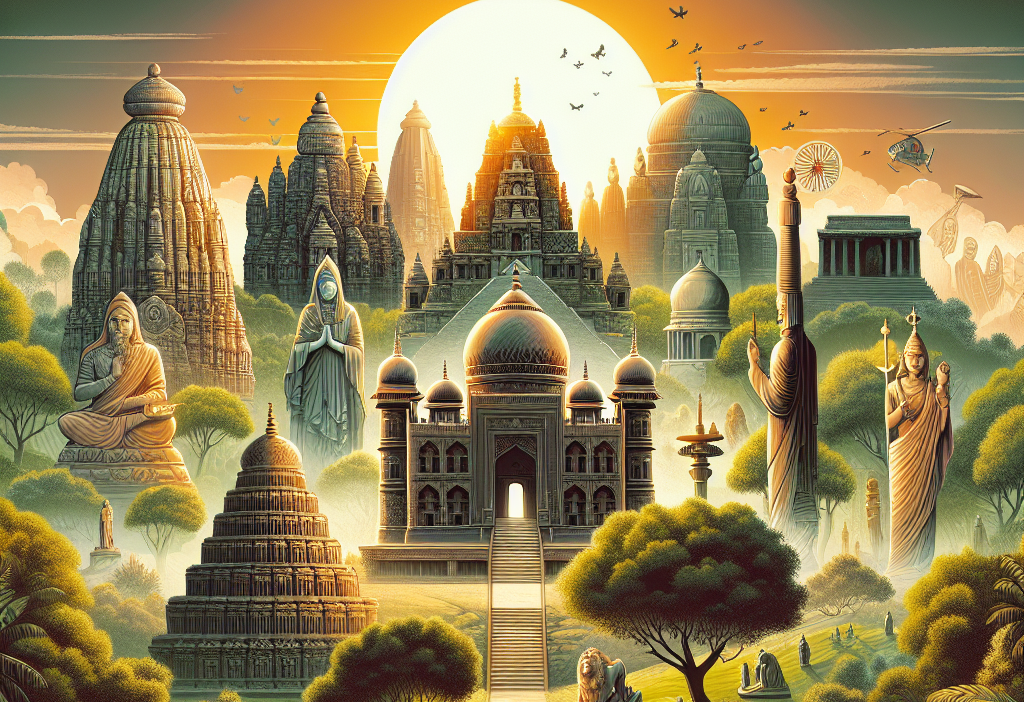
India’s architectural heritage is a testament to its religious diversity:
- Hindu Temples: Richly adorned, these structures reflect intricate craftsmanship and religious devotion.
- Islamic Architecture: The Taj Mahal serves as a prime example of Mughal influence, admired globally for its beauty and design.
Literature and Arts
India’s literary heritage is deeply interwoven with its religious traditions. Notable works include:
- The Vedas and Upanishads: Foundational texts that provide philosophical insights.
- Classical Literature: Works such as the Mahabharata and Ramayana blend storytelling with moral and ethical teachings.
Chart 2: Major Artistic Contributions Influenced by Religion
| Art Form | Influencing Religion | Notable Examples |
|---|---|---|
| Temple Architecture | Hinduism | Brihadeeswarar Temple, Khajuraho Temples |
| Mughal Architecture | Islam | Taj Mahal, Red Fort |
| Classical Dance | Hinduism | Bharatanatyam, Odissi |
The Contemporary Landscape: Religion in Modern India
Faith and Society Today
In contemporary India, faith continues to impact various spheres:
- Politics: Political parties often mobilize votes along religious lines, leveraging communal identities.
- Economics: Religion influences various sectors, including tourism, education, and healthcare.
Interfaith Relations
The Pew Research Center reported that India is one of the most religiously diverse countries in the world. This diversity presents both opportunities for pluralism and challenges in communal harmony.
Secularism and Religious Freedom
India’s constitution guarantees freedom of religion, yet the intersection of faith and national identity often complicates secularism. Ongoing debates about the role of religion in public life remain pertinent.
Conclusion
Religion has profoundly influenced India’s historical landscape, shaping its social structures, economies, and cultures. Understanding Faith and Foundations: The Impact of Religion on India’s Historical Landscape allows us to appreciate the complexities that define modern India.
As we navigate the intricacies of belief in today’s world, it’s essential to recognize that while faith can divide, it can also unite. So, let us embrace diversity and endeavor to build bridges among differing beliefs, for in understanding lies the key to unity and progress.
FAQs
1. How has Hinduism shaped Indian society?
Hinduism has significantly influenced social norms, castes, and governance, providing a cultural backbone that integrates spirituality with daily life in India.
2. What role did Buddhism play in ancient Indian governance?
Buddhism, particularly through Emperor Ashoka, introduced concepts of non-violence and welfare, which redefined moral governance in ancient India.
3. How do interfaith relations affect modern India?
Interfaith relations are crucial in fostering communal harmony. While they present challenges, they also provide opportunities for dialogue and understanding amidst diversity.
4. What are the main contemporary challenges related to religion in India?
Contemporary challenges include caste discrimination, interfaith marriages, and tensions surrounding religious conversions, often sparking intense debate.
5. How does religion influence the arts in India?
Religion heavily influences various art forms in India, from classical dance and music to architecture, creating a rich and diverse cultural heritage.
By understanding Faith and Foundations: The Impact of Religion on India’s Historical Landscape, we gain insights into how spirituality shapes our identities and how we relate to one another in an increasingly interconnected world. Let’s continue exploring these interconnected journeys of faith and culture, fostering unity in diversity. ✨